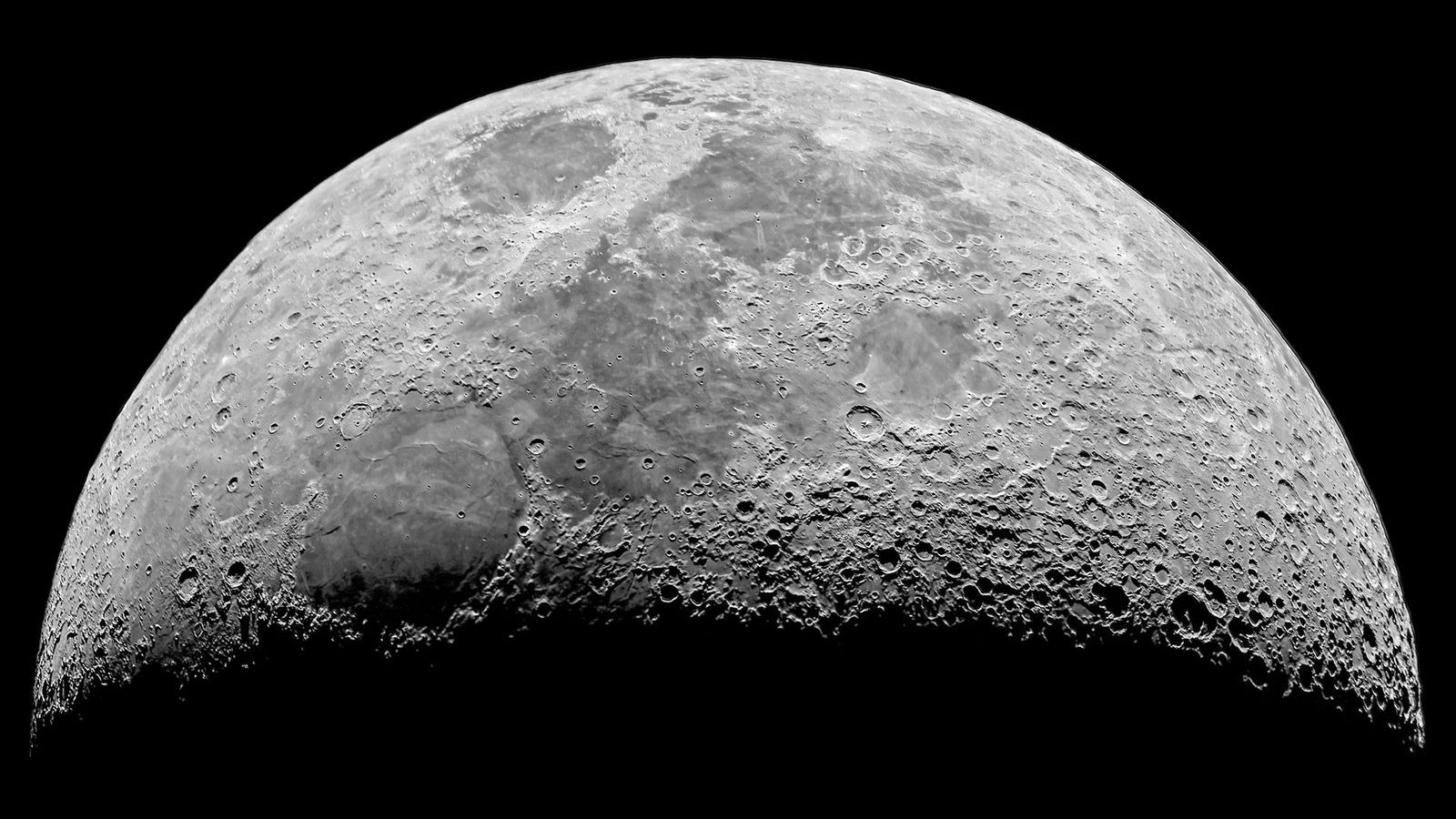
On 6 April 2026, Flight Day 6 of Artemis II, four astronauts flew past the Moon, taking turns to photograph it, annotate images and describe aloud what they saw. Six months later, the record has been made public.
On 7 October 2026, the US space agency NASA announced the release of Artemis II lunar science data and images. The total exceeds 800 GB, some of it never released before, and has been uploaded to the Planetary Data System. NASA describes it as the first planetary science dataset captured primarily by humans in more than half a century.
In other words, the main recorders of this data were the crew, not automated probes.
The archive the four astronauts brought back
The crew were NASA astronauts Reid Wiseman, Victor Glover and Christina Koch, and Canadian Space Agency astronaut Jeremy Hansen. According to NASA, the release includes:
- More than 11,000 full-resolution images and videos, from the crew's handheld cameras and from cameras on the Orion spacecraft.
- 8.5 hours of audio in which the crew describe their scientific observations.
- Images annotated by the crew.
- Three documents: the Artemis II Preliminary Lunar Science Report, the Artemis II Lunar Science Operations Report and the Artemis II Lunar Science Data User Guide.
The automotive and technology outlet autoevolution reported on 12 October 2026 that the scale of the data (over 800 GB, about 11,000 images and videos, 8.5 hours of audio) matches NASA's account, and said the data is available free of charge from the Planetary Data System (as of October 2026). On 8 October the American Institute of Aeronautics and Astronautics (AIAA), relaying a SpaceNews report, said NASA released the preliminary science report and the full dataset about six months after Orion's crewed lunar flyby, describing it as handing the data over to the science community.
Seven hours behind the Moon
The space news site Universe Today reported that on 6 April the crew completed a lunar far-side flyby of about seven hours, setting a new record for the distance of a crewed spacecraft from Earth, at more than 400,000 km.
The same report says the images show impact craters, ancient lava flows and surface cracks, as well as an Earthrise, an Earthset and the Sun's corona during an eclipse. These are the media's descriptions of the images; this article has not verified what scientific conclusions the reports published with the data reach, so it does not relay them.
Impact flashes: circled, but not settled
NASA's release mentions a tablet screenshot from 7 April. On a visualisation showing the Moon blocking the Sun, the crew circled impact flashes they saw: Wiseman in blue, Glover in green and Hansen in red.
NASA says some of the circled flashes may be the same impact event observed at different times. These are preliminary annotations, not verified conclusions.
As for the number of flashes, Universe Today reported six, but that figure has no direct counterpart in NASA's 7 October release and should be treated as a media claim.
Where confirmed ends and further study begins
Officially announced
- Scale: over 800 GB, over 11,000 images and videos, 8.5 hours of audio.
- Timing: during the lunar flyby on 6 April 2026, with the crew taking turns to photograph, annotate and record.
- Destination: uploaded to the Planetary Data System for further study by the global science community and the public.
- The names of the three accompanying documents.
Still preliminary, or reported only by the media
- Whether the flashes are the same event: NASA says these are preliminary annotations only.
- The exact number of impact flashes: a media claim only.
- NASA says the data is already helping inform planning for Artemis III and beyond, but this article could not verify the details.
- Universe Today says NASA scientists are analysing the images, audio and impact data and comparing them with amateur astronomers' observations to refine the timing and location of impacts; this is a media report, and this article has seen no official timetable.
Handing the Moon's data to everyone
NASA describes this as the first planetary science dataset captured primarily by humans in more than half a century. This time, the data comes with the astronauts' annotations on the images and 8.5 hours of spoken description. Which flashes are the same impact, and what else the images contain, remain to be studied.
As of October 2026, media reports say the data is available free of charge, and NASA says it is for further study by the global science community and the public.
Prices and details correct as of October 2026
Compiled by the F50 Editorial Team from public sources, for general reference only and not professional advice. Details are correct as of the publication date and may change.
Sources
- NASA: NASA Releases Artemis II Lunar Science Data, Images ()
- AIAA (reporting SpaceNews): NASA Makes Artemis II Lunar Mission Science Data Public ()
- autoevolution: NASA Releases 800 GB of Crewed Lunar Mission Data, Everyone Has Access ()
- Universe Today: NASA Releases Images of Artemis II's Flight Behind the Moon ()
Corrections
Spotted an error? Email support@wedo-search.com