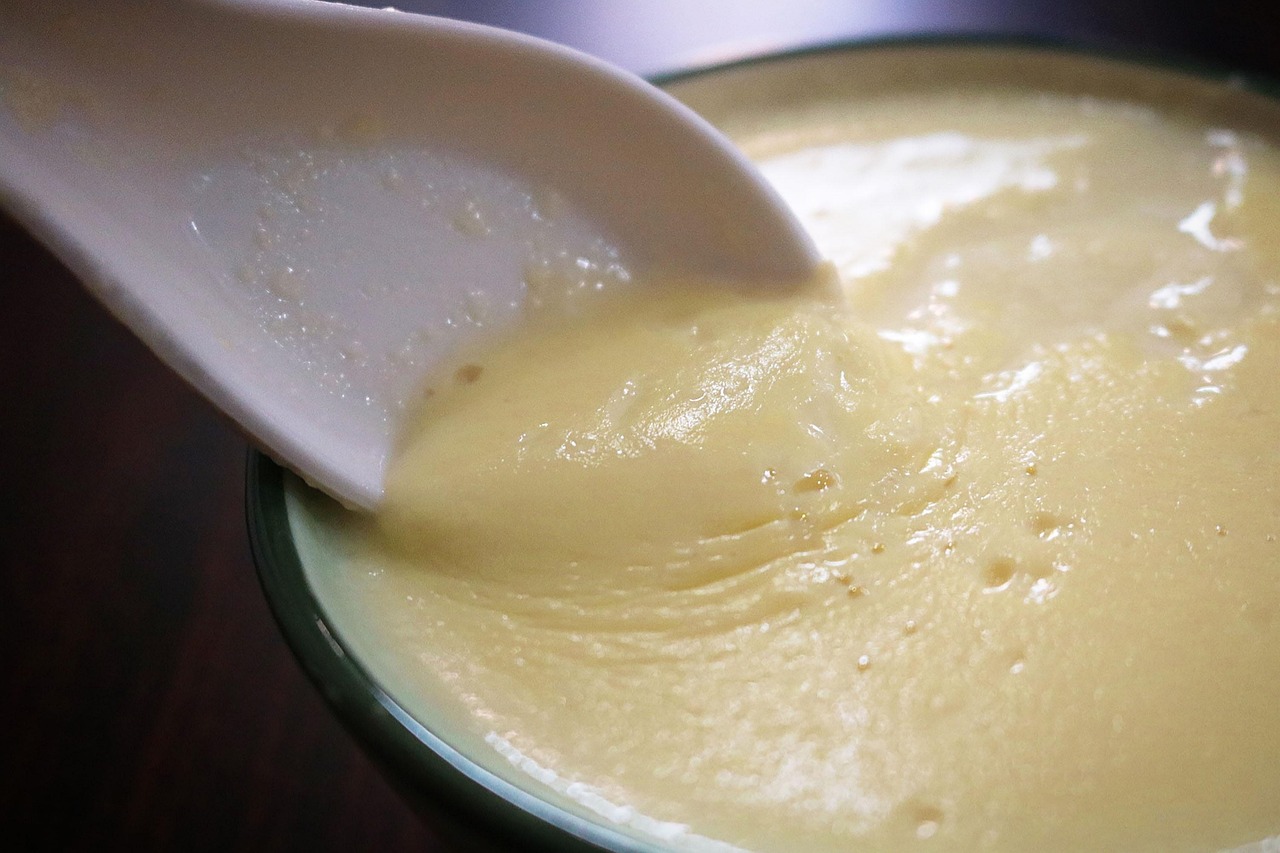
Whether a steamed egg comes out smooth or full of small holes depends on the egg-to-water ratio, the heat and how the bowl is covered.
The methods of three publishers, Hong Kong 01, TVBS Health 2.0 and Edh.tw (Everyday Health, Taiwan), agree on two points: the usual egg-to-water ratio falls between 1:1.5 and 1:2, and once the water boils the heat is turned down to medium-low or low rather than kept high throughout. They differ on how to choose the ratio, how long to steam and what to cover with. This article organises the three approaches into a guide; the information was checked as of November 2026.
Egg-to-water ratio: 1:1.5 is richer, 1:2 is smoother
All three publishers treat 1:1.5 to 1:2 as the usual range. With less water the egg flavour is stronger and the texture is close to pudding; with more water the texture is smoother. The method of Hong Kong chef Ricky on his YouTube channel (as summarised by TVBS Health 2.0) draws exactly this line: 1:1.5 for a rich egg flavour, 1:2 for a smooth texture.
Hong Kong 01's own test, however, gave a different answer: the ratio that worked most easily was 1:1.5. In the same test, 1:1 was overcooked because there was too little water and the egg mixture was too thin, and 1:2 steamed for 8 minutes was still overcooked. The chef interviewed, Lui Kai-yu (雷啟裕), said the ratio depends on personal taste and that 1:3 is softer.
So 1:2 failed in the Hong Kong 01 test but is the smooth option in the methods of Ricky and Edh.tw. The heat, quantities and timings differ between them, and the sources do not explain the discrepancy. It appears that the ratio should not be compared without the heat.
Quick ratio reference
- 1:1: in the Hong Kong 01 test there was too little water and the egg mixture was too thin, so it was overcooked.
- 1:1.5: richer egg flavour, pudding-like texture; the easiest to get right in the Hong Kong 01 test, and also the ratio used in Hong Kong 01's Easter egg article.
- 1:2: smoother texture; Ricky uses 3 eggs (about 160 g) with 320 g of water, and Edh.tw uses one medium egg (about 50 ml of beaten egg) with about 100 ml of water. Both pair it with 12 to 15 minutes on low or medium-low heat.
- 1:3: found only as the personal preference of Lui Kai-yu, who said the texture is softer.
Where the honeycomb holes come from
The small holes on the surface of a steamed egg are commonly called honeycomb (蜂窩); Hong Kong 01 also calls them Mars craters (火星坑洞). The sources stress different causes, but these fall into three groups.
- Bubbles not dealt with: Edh.tw says the bubbles beaten into the egg were not strained out; Hong Kong 01's Easter egg article advises adding salt and skimming off the foam; TVBS's reprint of the Hong Kong 01 article adds that small bubbles not removed, and egg white not beaten evenly, also cause dents.
- Heat too high: Hong Kong 01 says high heat sets the surface quickly, producing craters and overcooking the egg; Edh.tw says that when the temperature in the pot is too high, the water in the egg mixture boils and produces gas.
- Continued heat absorption: Hong Kong 01 says the egg keeps absorbing heat and expanding, which also produces honeycomb, so cover it with cling film or foil, or lift the lid to release steam.
Heat and time: no single standard answer
The shared step is to bring the water to the boil first and then turn to medium-low or low heat. How long to steam varies considerably.
- Hong Kong 01 test (1:1.5): 5 minutes on medium heat without releasing steam; or 1 minute on high heat, 1 minute with the lid open to release steam, then 4 minutes on gentle heat. Both came out smooth.
- Hong Kong 01 Easter egg article (1:1.5): 6 minutes on low heat, then 4 minutes off the heat with the lid on, generally kept to about 10 minutes.
- Ricky (1:2): 12 to 15 minutes on low heat.
- Edh.tw (1:2): 12 to 15 minutes on medium-low heat, then 3 more minutes off the heat with the lid on.
In other words, timings from 5 to 15 minutes are in use. Hong Kong 01's Easter egg article says the time varies with the number of eggs, the ratio, the depth of the egg mixture and the material of the steamer, so a single figure should not be copied. The same test also shows that low heat is no guarantee: 1:1 steamed for 10 minutes on low heat was still overcooked.
A more practical approach is to check partway through. Ricky suggests that if you worry about overcooking, lift the lid at the 10th or 11th minute: if the centre still wobbles slightly, it is about 80 to 90 per cent set, and can be steamed or left to sit with the heat off for 2 more minutes.
Covering: a gap, a plate or cling film
This is where the three sources differ most; which to choose depends on what you have to hand.
- Cling film or foil: Hong Kong 01 says that once covered there is no need to release steam, and it also keeps water dripping from the lid off the egg; TVBS's reprint warns that cling film must be a heat-resistant type so that it does not melt. Edh.tw advises heat-resistant cling film with 3 to 5 small holes poked in it.
- A small plate: Hong Kong 01's Easter egg article mentions covering with cling film or a plate, and Edh.tw also advises covering the bowl with a small plate; the aim in both is to stop water dripping onto the egg.
- Lid left ajar: Ricky uses neither a plate nor cling film, and simply leaves the pot lid open a crack.
If nothing is covered, the Hong Kong 01 test lifted the lid about every 2 minutes to release steam, because otherwise the egg keeps absorbing heat.
Checklist of causes of failure
- Unsuitable ratio: for example 1:1, where there is too little water and the egg mixture is too thin, so it overcooks easily.
- Heat too high and steaming too long: the surface sets too quickly, forming craters and turning tough.
- Neither cling film nor releasing steam: the egg keeps absorbing heat and expanding.
- Foam not skimmed and mixture not strained: bubbles stay in the egg and become small holes.
- Egg white not beaten evenly: this also causes dents.
- Water dripping from the lid onto the egg: nothing such as cling film, foil or a small plate was used to shield it.
Smooth is good, but it must still be cooked through
Hong Kong's Centre for Food Safety says raw or undercooked eggs may cause salmonella infection, with the risk especially high for high-risk groups; mixed egg mixtures should be cooked thoroughly, and the best way is to reach a core temperature of 75°C or cook until the yolk is firm. When aiming for smoothness, if a check shows the centre has still not set, keep steaming or leave it to sit with the heat off until fully cooked before serving.
One last suggestion: decide first whether you want the richness of pudding or a texture that melts in the mouth, then match the heat. Among the methods listed, 1:1.5 with a shorter time and 1:2 with 12 to 15 minutes on low or medium-low heat are the two clearest routes.
Sources
Note: TVBS Health 2.0's article 'The perfect steamed egg ratio' is a licensed reprint of the same test by Hong Kong 01, so the independent publishers actually drawn on here are three: Hong Kong 01, TVBS Health 2.0 (the Ricky part) and Edh.tw. Other recipe websites could not be opened or found and were not used. No photographs from any source website are used. The information was checked on 2 November 2026.
- Hong Kong 01: 'Steamed egg tips: egg-to-water ratio, timing and 7 secrets, plus a chef on 3 big causes of failure, with 4 recipes' (蒸水蛋貼士|蛋水比例/時間等7秘訣+大廚揭3大失敗原因!附4食譜), published 30 May 2025 (updated 15 October 2025), https://www.hk01.com/article/480507
- TVBS Health 2.0: 'The perfect steamed egg ratio! A Hong Kong chef's tips for smooth, tender steamed egg' (最完美的蒸蛋比例!香港大廚教蒸蛋訣竅 做法簡單、蒸蛋滑嫩美味), 21 April 2025 (updated 18 August 2026, licensed reprint from Hong Kong 01), https://health.tvbs.com.tw/nutrition/354372
- Hong Kong 01: 'Easter eggs: 14 egg dishes from 9 places, with reliable steamed egg and onsen egg methods' (復活節蛋 9地14款蛋料理超有代表性 附蒸水蛋、溫泉蛋不敗做法), published 7 April 2023 (updated 18 February 2025), https://www.hk01.com/教煮/884673/復活節蛋-9地14款蛋料理超有代表性-附蒸水蛋-溫泉蛋不敗做法
- TVBS Health 2.0: 'Simpler than the Xiaohongshu steamed egg! A Hong Kong chef's secret to smooth steamed egg, no plate or cling film needed' (比小紅書蒸蛋還簡單!香港名廚曝蒸蛋滑嫩祕訣 不用蓋盤子、保鮮膜), 3 July 2025 (updated 12 December 2025), https://health.tvbs.com.tw/nutrition/356007
- Edh.tw (Everyday Health): 'What is the steamed egg ratio? Techniques for smooth steamed egg in a rice cooker or microwave' (蒸蛋比例是多少?電鍋、微波爐滑嫩蒸蛋零失敗技巧公開), 22 June 2026, https://www.edh.tw/article/36239
- Centre for Food Safety, Hong Kong: 'Food safety of eggs and egg products' (蛋及蛋製品的食用安全), page undated, checked 2 November 2026, https://www.cfs.gov.hk/tc_chi/whatsnew/whatsnew_fst/whatsnew_fst_Food_safety_of_eggs_and_eggs_products.html
Prices and details correct as of November 2026
Any recipe amounts, temperatures and times are compiled from several sources and are a guide only. Take food-safety care with raw, allergenic or high-risk ingredients.
Sources
- 香港01: 蒸水蛋貼士|蛋水比例/時間等7秘訣+大廚揭3大失敗原因!附4食譜(2025-10-15 更新);核實日 2026-11-02) ()
- TVBS 健康2.0: 最完美的蒸蛋比例!香港大廚教蒸蛋訣竅 做法簡單、蒸蛋滑嫩美味(2026-08-18 更新);授權轉載自香港01) ()
- 香港01: 復活節蛋 9地14款蛋料理超有代表性 附蒸水蛋、溫泉蛋不敗做法(2025-02-18 更新) ()
- TVBS 健康2.0: 比小紅書蒸蛋還簡單!香港名廚曝蒸蛋滑嫩祕訣 不用蓋盤子、保鮮膜(2025-12-12 更新) ()
- 早安健康: 蒸蛋比例是多少?電鍋、微波爐滑嫩蒸蛋零失敗技巧公開 ()
- 香港食物安全中心: 蛋及蛋製品的食用安全(頁面未列日期;核實日) ()
Corrections
Spotted an error? Email support@wedo-search.com